How Much Exercise Does a Chow Chow Need? Plus Brain Games
General training information. Every dog is an individual; for health or behavior concerns, see your veterinarian.
The Chow Chow is not a dog that begs for a long run. It is also not a couch ornament. Most of them land in the middle, and that middle is easy to get wrong. Too little and you get a bored, stubborn dog. Too much, especially in warm weather, and you get a tired, overheated one.
This guide shows you how much exercise a Chow Chow needs, how to build a daily routine, and how to add brain games that suit what the breed was developed to do. Individual dogs vary, so treat every number here as a starting point and adjust with your veterinarian.
The Short Answer
Orvis describes the breed as needing no vigorous exercise, but about an hour of moderate exercise each day. It also notes that Chow Chows tire quickly and that heat can be a problem. The Canine Bible breed page agrees on the general picture: moderate energy, and a dog that enjoys daily walks but is not overly active or playful.
So the working answer to how much exercise a Chow Chow needs is this: aim for roughly an hour of moderate activity, split into sessions, and keep the pace easy. Then add mental work, because a thinking dog is a calmer dog.
Why Brain Work Matters for This Breed
Orvis calls the Chow Chow intelligent but highly independent and stubborn. The Canine Bible says the breed needs experienced, consistent training. A dog like that does not always take direction well from a boring routine. Give it a job to think about, and you often get more cooperation.
The Canine Bible also notes the breed began in northern China more than 2,000 years ago as a working dog used for hunting, guarding and pulling carts. That history is a useful guide for choosing games. Scent work echoes hunting. Calm watchfulness echoes guarding. Steady, purposeful effort echoes the cart work.
Chow Chow mental stimulation does not need to be fancy. It needs to be regular, short and rewarding.
Materials You Will Need
- A flat collar or a well-fitted harness, and a standard leash of about six feet
- Small, soft treats, cut pea-sized, or part of the dog's daily meal measured out
- A puzzle feeder or snuffle mat
- A few cardboard boxes, towels or old muffin tins for homemade games
- A shady route and fresh water for every outing
- A brush, since a heavy double coat collects burrs and debris on walks
- A notebook or phone notes to track how your dog handles each day
Step-by-Step: Build a Daily Exercise Routine
Step 1: Check your dog's health first
Before you set a routine, talk with your veterinarian. Orvis lists hip dysplasia, elbow dysplasia, patellar luxation, gastric torsion, an elongated palate and eye disorders among the health issues seen in the breed. Several of these affect how a dog should move, breathe and eat around exercise.
Ask your vet what activity level is right for your individual dog, and whether they suggest any timing around meals. Do not diagnose problems yourself. If your dog limps, struggles to breathe or seems unusually tired, stop and call your vet.
Step 2: Split the hour into short sessions
Because Chow Chows tire quickly, one long outing is often a poor fit. Try three shorter sessions instead:
- A morning walk at a relaxed pace
- A midday or afternoon sniff walk or brain game session
- An evening walk, once the day has cooled
Together these can add up to the hour Orvis describes. If your dog is happy and recovers quickly, you are in the right range. If your dog lags, pants hard or sits down on the route, shorten the next outing.
Step 3: Match the plan to your dog's life stage
The sources I relied on do not give exact minutes for puppies or seniors, so I will not invent them. Here is how to think about each stage, and where to get firm numbers.
| Life stage | What to do |
|---|---|
| Puppy | Keep activity gentle and play-based. Ask your vet and your breeder how much is safe for growing joints, since hip and elbow dysplasia are listed concerns in the breed. Avoid forced running, long hikes and repeated jumping until your vet says otherwise. |
| Adult | Work toward the roughly one hour of moderate daily exercise Orvis describes, in short sessions, with extra care in warm weather. |
| Senior | The Canine Bible gives a life expectancy of 8 to 12 years. As your dog ages, ask your vet how to adjust. Many owners shorten walks and add more sniffing and gentle games. |
For puppies, the Chow Chow Club's welfare article says training starts the day the dog comes home. It also stresses socialization before 12 to 16 weeks, with a second fear period at 6 to 8 months. Exercise in those early months is a chance to meet new sights and sounds calmly, not to log distance.
Step 4: Plan for heat
Orvis notes that heat can be a problem for the breed. The Canine Bible and Orvis both describe a thick double coat. Build your routine around that.
- Walk in the early morning and late evening during warm months.
- Choose shaded routes and carry water.
- Test the pavement with the back of your hand. If it is too hot for you, it is too hot for paws.
- Move brain games indoors on hot days. They tire a dog out without any heat risk.
- Know the signs of overheating, such as heavy panting, drooling or reluctance to move, and call your vet right away if you see them.
Step 5: Make one walk a sniff walk
A sniff walk lets the dog lead with the nose. It suits a breed that was used for hunting, and it is easy on the body because the pace is slow.
- Pick a quiet, familiar route with plenty of grass and edges.
- Say a cue such as "go sniff" and stand still on a loose leash.
- Let your dog investigate for as long as it likes, within reason.
- When you want to move on, use a cheerful cue and reward the dog for coming along.
Many owners find that ten relaxed minutes of sniffing feels more satisfying to the dog than a brisk march. Because the Chow Chow is standoffish with strangers, per Orvis, a quiet route also keeps the walk low-stress for both of you.
Step 6: Feed some meals from puzzles
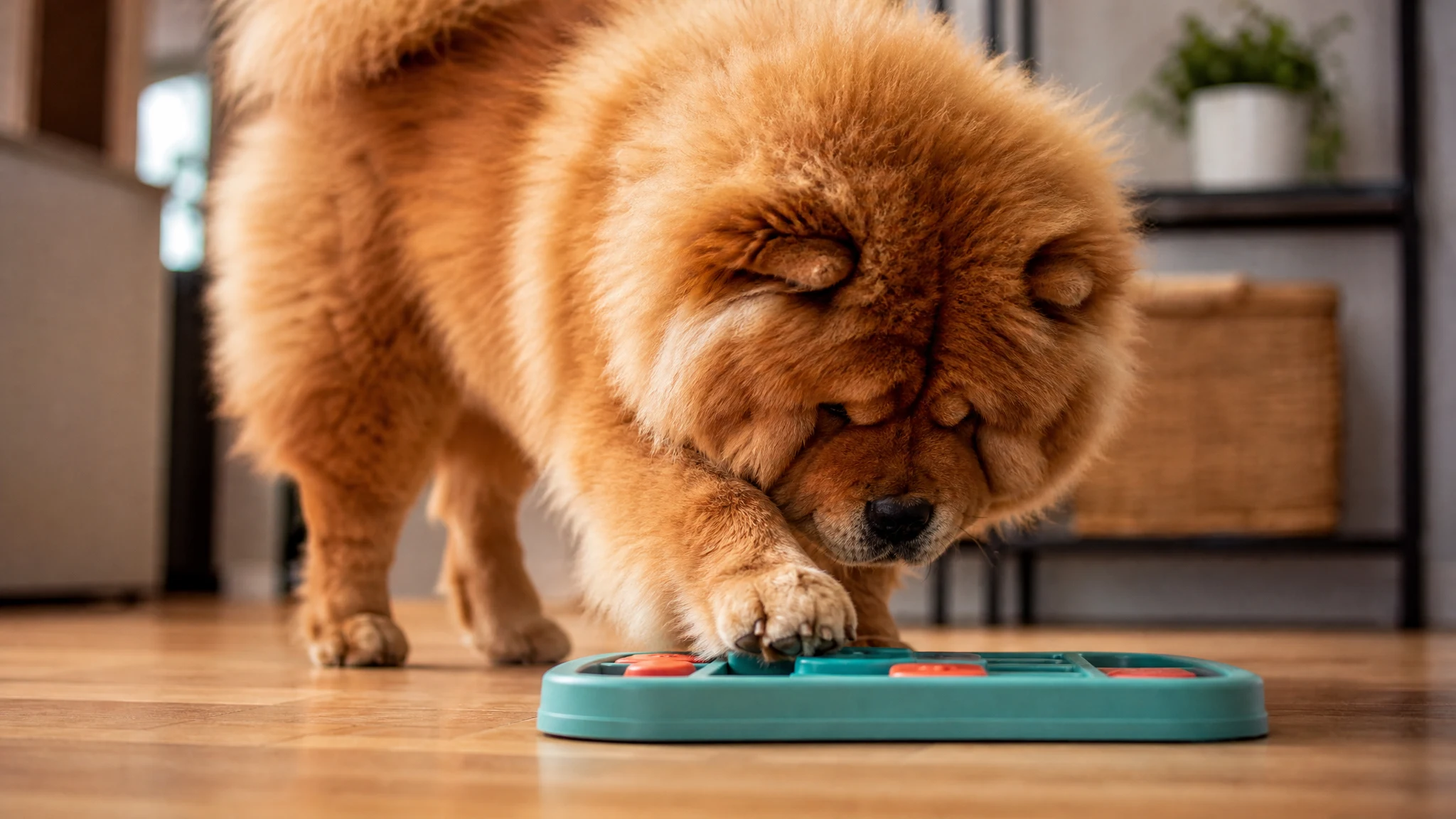
Puzzle feeders turn mealtime into a task. Use part of the regular meal, not extra food, so weight stays steady.
- Start with an easy setup, such as kibble scattered on a snuffle mat.
- Let your dog succeed within the first minute.
- Increase the difficulty slowly, one small change at a time.
- Pick up the toy when it is finished and wash it.
If your dog shuts down or walks away, the puzzle is too hard. Go back a step. Stubborn dogs quit fast when they feel stuck.
Step 7: Play training games tied to the breed's old jobs
These short games take five minutes or less. Use rewards, a calm voice and plenty of patience. Never use force, harsh corrections or intimidation, which fall outside the humane, reward-based approach recommended by the American Veterinary Society of Animal Behavior.
Hunting: find-it games.
- Show your dog a treat, then drop it a few feet away and say "find it."
- Once your dog gets the idea, hide treats under towels or inside cardboard boxes.
- Move to hiding treats in another room while your dog waits.
The Chow Chow Club lists Barn Hunt and Tracking among the activities Chow Chows do. Find-it games are a gentle, at-home introduction to the same kind of nose work.
Guarding: the calm watch and settle.
The breed is described as protective and territorial. Rather than encouraging guarding behavior, teach your dog to relax on cue.
- Place a mat in a quiet spot.
- Reward any step onto the mat, then any lie down.
- Add a cue such as "place" and slowly build the time before the treat arrives.
- Practice when visitors arrive, starting with calm, familiar people.
If your dog shows aggression, do not try to handle it alone. The Chow Chow Club's welfare article warns that serious problems such as aggression are not for group classes. Talk to your vet, who can help you find a qualified behavior professional.
Cart pulling: purposeful, steady effort.
You do not need a cart. The same idea works as loose-leash walking with a goal. Pick a landmark, walk toward it at a steady pace, and reward your dog for staying beside you. It gives the walk a purpose without adding strain.
Everyday cooperation.
Practice "sit," "down," "touch" and "leave it" in short bursts. For the full foundation, see our complete guide to training a Chow Chow.
Step 8: Consider a dog sport for the long term
The Chow Chow Club's Obedience and Performance page lists Obedience, Rally, Agility, Barn Hunt, Trick Dog, Canine Good Citizen and Tracking for the breed. You do not need to compete. Trick Dog and Canine Good Citizen are good goals for owners who want a structured way to train and bond. Check with your vet before starting any high-impact activity such as agility.
A Sample Day
- Morning: 20 minute easy walk, then a short "place" practice
- Midday: part of a meal in a puzzle feeder, plus a five minute find-it game
- Evening: 20 minute sniff walk in the cooler air, then a few cooperation cues at home
Adjust the times to your dog's age, health and the weather.
Tips for Better Sessions
- Keep it short. End while your dog still wants more.
- Use real rewards. A tiny piece of something your dog loves beats a dull biscuit.
- Be consistent. The Canine Bible stresses clear, firm boundaries. In practice that means the same rules from everyone in the house, enforced with calm, reward-based training.
- Brush after outings. Heavy seasonal shedding, noted by Orvis and the Canine Bible, means a thick coat that needs frequent brushing.
- Socialize early and gently. The Canine Bible says early socialization is key, since the breed can be reserved with other dogs.
- Watch for the one-person bond. Orvis says Chow Chows often bond with a favorite person. Let other family members handle some rewards and games too.
Common Mistakes to Avoid
- Treating the breed like a jogging partner. Long, fast runs do not suit a dog that tires quickly and struggles in heat.
- Skipping mental work. A walk alone may not satisfy an intelligent, independent dog.
- Pushing a puppy too hard. Growing joints need care. Get your vet's guidance before adding distance, stairs or jumping.
- Exercising at midday in summer. Shift to early and late hours.
- Using harsh methods when the dog digs in. Stubbornness is part of the breed. Make the task easier, raise the reward and try again later.
- Taking a reactive or aggressive dog to a group class. The Chow Chow Club advises against it. Seek individual help.
- Ignoring pain signals. Limping, stiffness or reluctance to move are reasons to call your vet, not reasons to push on.
What Results to Expect
Every dog is different, and results depend on age, health and consistency. With a steady routine, many owners notice that their dogs settle more easily at home, show more interest in training and handle walks with less pulling. Mental games may help channel energy that would otherwise go into chewing or digging, though they are not a cure for behavior problems.
Give any new routine a few weeks before judging it. If your dog seems worse, such as more anxious, more reactive or in discomfort, scale back and call your vet.
Where to Get Firm Numbers
Exact exercise limits for puppies and seniors, and the full list of recommended health tests, are best confirmed with your veterinarian, your breeder and The Chow Chow Club, Inc. The club's health committee says its pedigree database records Hip, Elbow, Patella, Thyroid and Cardiac certifications through OFA, plus CERF eye exams and CHIC. Ask your breeder which of these were done on your puppy's parents.